
FGG TIMES
సుపరిపాలనే ధ్యేయంగా
Vol. No. I | Issue No. 9 | Monthly News Letter | September 2025
IN FOCUS
Grievance redress is key to good governance
The effectiveness of an organization is measured in redress of grievance. Typically grievance arises as a result of failure of service delivery at the promised level in terms of time and quality or when the rights of a citizen are not honoured or violated. Grievance redress forms the core of good governance since it builds trust between the government and citizen. It ensures accountability of officials and institutions and helps in tackling corruption. A grievance is an indicator of bottleneck in governance process and a source to prevent public dissatisfaction.
The issue of grievance redress was addressed in the 2 nd Administrative Reforms Commission (2005). It aimed to enhance efficiency, transparency and accountability of administrative framework. Following the recommendations state governments were obligated to create grievance redress authorities to deal with delays, harassment, corruption and violation of rights of citizens. The report further recommended that government organizations should analyze complaints received and identify areas for intervention to eliminate causes leading to grievance. The Commission’s salutary contribution lies in impelling the executive to legislate Right to Information Act, 2005 which empowers a citizen to seek information from government organizations and pursue grievance for effective redress. Initiatives taken up subsequently such as creating CVC (Central Vigilance Commission, NHRC (National Human Rights Commission), Lokayukta are aimed at taking cognizance of complaints of violation of rights of citizens, abuse of office by public servants, negligence in conduct of duties by a public servant. In course of time Citizen Charter
was issued. Tax-payer grievances and their early resolution are being addressed through e-Nivaaran.
The Parliamentary Standing Committee on Personnel, Public Grievances, Law and Justice in its 25th Report recommended that grievance redress must be made citizen friendly by setting Information and Facilitation kiosks and minimizing paper work. It further suggested that grievance redress must be decentralized to local or regional offices to ensure faster resolution. The report also emphasized the need to establish feedback mechanism like response time, resolution rate and citizen satisfaction.
In the context of rising expectations of citizens for faster and quality service delivery the Ministry of Personnel, Public Grievances and Pensions (GOI) issued comprehensive guidelines for making grievance redress time-bound, accessible and effective. Timeline for effective grievance redress has been reduced to 21 days from 30 days. Further the guidelines state that dedicated grievance cells shall be set-up in every ministry/department with a Nodal officer and staff having knowledge of schemes and programmes. The CPGRAMS (Centralised Public Grievance Redress and Monitoring System) which was launched in 2022 is an integrated user-friendly grievance filing platform which will provide citizen a single window experience and help de-duplication and save time and effort of officials from resolving same grievance on multiple portals. The Department of Administrative Reforms and Public Grievances (DARPG) in its 29 th report states that pendency of grievances in states and Union Territories in December 2024 stands at 1,85,519.
Prajavani of Telangana, a replica of GRM (Grievance Redress Mechanism) has received a total of 6,31,934 issues across 33 districts and disposed of 5, 48,318 with 83616 issues awaiting resolution. There is no gainsaying that majority issues pertain to land related issues affecting a large number who depend on land for survival. It is often said that with statistics one cannot prove everything but one can always find something good or bad to say. Even as one welcomes the initiatives the very fact that there is an implosion of grievances at various levels of governance is a matter of concern. The multitude that converges at Praja Bhavan in Hyderabad on Prajavani days is a sure sign of administrative indifference and apathy of officials at the grass root level. The growing discontent and disaffection of citizen towards state does not bode well for democracy. One can only hope the voice of hapless citizen is not a cry in wilderness.
T.Vivek
(E.C.Member FGG & Former Member TSPSC)
Government Fee Reimbursement Scheme (FRS) A Dream turned Nightmare
The dream of higher education in professional programs – engineering, medicine, business administration, pharmacy, nursing etc – was made easier in Telangana by the State Government’s Fee Reimbursement Scheme (FRS). The aim of the initiative first started in the undivided Andhra Pradesh in 2008, is to support students from Scheduled Castes, Scheduled Tribes and Backward Classes to pursue a professional career by supporting their fees.
Professional Courses in Private Colleges
This became necessary as private colleges were encouraged to teach professional courses in the 1980s. By 2009-10, the fee structure even for the so-called “free (government) seats”, which were cheaper, was ₹ 27,000 per annum. Fees for the management quota were three times that amount, making it hard for students from poor families to study professional courses. Technically, under this system, colleges first collect tuition fees from students, who then submit to the government for reimbursement. However, the positions are reversed here. Colleges are forced to accept students without charging them because the government has promised to reimburse them later.
With caste-based reservations constituting 50-60% of the total student intake, engineering institutions (particularly autonomous and affiliated) end up expecting 40-60% of their revenue from the government via the FRS. The revenue generated through the direct collection of tuition fees from general category students is only 50-60% of the total expected revenue.
Details of Reimbursement:
SC and ST Category Students – 100%
Minority Category & PHC Students – 100%
OBC Category Students – Fixed Amount as Decided by TFRC
EBC Category Students – Fixed Amount as Decided by TFRC
General (OC) & Management Quota Students – NIL
Eligibility Criteria: As per the brochure from TS Education Dept
In recent years, however, delays in these payments have put a severe financial burden on private and unaided colleges. Regular operations of these colleges have been affected, and discontent has been rising among both educators and students.
Dark Side of the FRS
The combination of both the caste-based reservations and the fee reimbursement policies, although a boon to students, has become a curse to these professional institutions. Together, both policies have forced all autonomous and affiliated engineering institutions to depend on government scholarships for 40-60% of their overall revenue.
Engineering institutions in Telangana have been struggling financially for over a decade due to significant delays in the disbursement of fee reimbursements from the government. The release of fee reimbursement dues by the government is often delayed by 3-4 years without any assurance of timely disbursal.
Forced to operate at significantly lower budgets, most institutions merely end up using all their revenue for staff payroll without any investment in infrastructure, technology, research, and development. In a lot of cases, institutions are struggling to even pay faculty salaries for a few months when they run out of direct collections from tuition fees from students. More than Rs. 6,500 Cr, over the last 4 years, is still unpaid to private engineering institutions in the state today.
In recent years, however, the government has not released funds under the program as planned, instead making small installments. Changes in government reimbursement guidelines have put students and private institutions in a deep financial crisis. At least 75 colleges are up for sale, including 50 in and surroundings of Hyderabad. “The government policies that encourage Higher education through a fee- reimbursement system left hundreds of corporate institutions in the red”. Salaries had to be withheld, which forced many of these colleges to announce their willingness to accept students who did not even pass the entrance exam.
The curse of the fee reimbursements has therefore led to little or no growth among the majority of the private engineering institutions in Telangana as measured by their presence in the top 100 NIRF ranks. In the 2024 ranking, no private engineering college in Telangana was ranked amongst the top 100 in India with only one private university ranked 98th in the country.
All such engineering institutions will see the light at the end of the tunnel only when they transform themselves into universities. The caste-based reservations and the government fee reimbursements currently do not apply to private universities thereby allowing them full control over their revenue and finances. As per the vision of NEP 2020, the UGC has opened up opportunities for affiliated institutions to evolve into autonomous institutions and later universities. Eligibility for transformation to universities requires institutions to showcase quality standards (as per NAAC and NBA accreditation norms) for over a decade.
However, there is a serious threat to the survival of the majority of the affiliated and autonomous colleges as they compete with the growing number of newly established private state universities.
Impact on Quality of Education
College authorities have already hired educational consulting firms and private agents to help students gain admission to colleges by providing them with numerous tools for example free transportation, free laptops, and subsidized dormitory facilities.
The financial burden on the Ministry of Finance is increasing year by year as the number of institutions increases as well as most students take advantage of the government’s tuition reimbursement scheme. More than 80 percent of enrolled students claim the fee-reimbursement.
Business leaders use consultants and brokers to fill college seats, paying approximately Rs.10,000 to 20,000 each applicant. The students who do not have interest to pursue higher education, these agents force them to enroll in colleges. Additionally, students do not have to pay any enrollment fees, so they receive a token amount to enroll in college regardless of whether they enroll. In most cases, these compulsory enrollments account for approximately 20-30 percent of total enrollment.
A senior government official at the Ministry of Higher Education said many institutions suffer from low standards. Many colleges have become degree production centers rather than knowledge centers. It is also true that only a few institutions in the country meet all criteria in terms of infrastructure, laboratories, libraries, and efficient and regular faculty.
The Way Forward
The Government of Telangana need to consider itself to be at a crucial juncture for engineering education in Telangana, as it will be witnessing the slow death of private engineering colleges and the dominance of state and deemed-to-be private universities. This paradigm shift will completely undo all the benefits of the caste-based reservation and fee reimbursement policies over the last decade in increasing access to engineering education for students from marginalized and low socioeconomic communities.
The government’s recognition and support of these institutions is absolutely critical through thoughtful restructuring of the implementation of FRS.
Three strategies are required to solve the problem
- First one would be, in place of spending millions of amounts on Higher education in the form of fee-reimbursement for vulnerable classes, this amount would have been diverted to all segments of the people by establishing high quality primary and secondary schools across the state. The cause is that the quality of higher education eventually depends on the quality of primary and secondary education.
- Second, specific national and international standard bodies should be established within the framework of public-private partnerships to strengthen higher education.
- To achieve better inclusion in higher education, only eligible students below the poverty line are given the opportunity to receive free education at these institutions.
Alternatively as some studies indicate better employment opportunities received by the students who were beneficiaries of FRS, the following may be suggested:
- Part of the fee (25-50%) may be paid by the parents and may be returned upon refund by the Government.
- The fee amount may be treated as an interest-free loan to the student and will be repaid one or two years after completion of the course. To facilitate / monitor the payment and repayment of the fee amount, an independent agency may be assigned. This is in practice in some states Bihar, Kerala etc.
- The whole process may be tagged to the CSR funds of industries, especially Public Sector Undertakings (PSUs).
- Government of India is allowing students to take bank loans from scheduled banks at an annual rate of around 4%. If the State Government acts as a collateral / guarantor and pay interest amount annually, the candidate will have to pay after completion of the course.
- As recommended by the Professional Colleges Managements Associations, let the student / parent pay the fee to the institution (may be in installments) and the reimbursement be made directly to the student / parent through bank.
The FRS as part of the heritage that the new Telangana has inherited. But it was not without the disappointment that came with it. Timely disbursal of the student scholarships will give impetus to the financial stability and therefore growth of engineering institutions in Telangana. It’s never too late to hope for collaborative efforts between the government and engineering institutions to position Telangana as one of the best destinations in India for high-quality education
Dr. A. Raghuram Rao
Life Member, FGG” (Views are personal)
“Gender equality is more than a goal in itself. It is a precondition for meeting the challenge of reducing poverty, promoting sustainable development and building good governance”.
Kofi Annan, Secretary-General of the United Nations (UN) from 1997 to 2006
ANTI DEFECTION LAW -ANALYSIS
IN INDIA from the very beginning, elections to the parliament and the State legislatures have been fought on party basis, and the electorates have always been impressed by the appeal of political parties based on their ideologies and programmes as incorporated in the election manifesto.
But since mid-1960s India’s experience with democracy witnessed a very unsavoury political development where many of elected representatives of the people in the parliament and State legislatures, in particular, have left the parties on whose party tickets they were elected and joined those very opponent parties. This unscrupulous floor-crossing was nothing else except for selling out of the sentiments of the electorates and thereby undermining of the very basis of democracy. The desire for influence, position, and cash was clearly behind this wonder rather than based on any common ideological or honest political dissent.
The on-going issues of defection in spite the successful adoption of elaborate provisions in Tenth Schedule of the Constitution and numerous conflicting opinions by the various High Court and the Supreme Court, have witnessed new developments in the form of resignation by some of the elected members of the largest political party in the State and their consequent joining and contesting the by election from the Second largest political party. In this process of reducing the adequate strength of the House, thereby facilitating the Second largest political party to form a government.
The Constitution 52nd Amendment Act, 1985 amended articles 101, 102, 190, and 191 of the Indian Constitution to include provisions for the vacation of seats and disqualification from membership of the House. It also added the Tenth Schedule, which outlines grounds for disqualification due to defection.
Basic Scheme of Tenth Schedule of the Constitution and Its Constitutionality
Articles 102(2) and 191(2) read with Tenth Schedule of the Constitution provides that any members of the Parliament and State legislature shall be disqualified from being members of the House in the following contingencies.
- (ii) “If elected members, who have been set up as a candidate by a political party or nominated members, who is a member of political parties at times he takes his seat, voluntarily given up his membership of such political parties.
- If he votes or abstain from voting in the House against any direction or whip of that political parties unless it has not been condoned by the party within 15th days from the date of voting or abstention.”18 Para 2(1)(b).
- An Independent candidate shall be disqualified for being a member of the house if he joins any political party after such election. Para 2(2).
- A nominated member of the house shall be disqualified for being member of the house if he joins any political parties after expiry of Six Months from the date on which he takes his seat in the House. Para 2(3).
The 91st Amendment made defection more difficult by removing the provision that did not consider mass shifting of loyalty by one-third members as defection. Instead, it recognized the merger of political parties. If an original political party merges with another party and at least two-thirds of the members of the legislative party agree to the merger, they are granted immunity from disqualification.
Speaker Responsibility in contested claim of voluntarily given up membership and merge with other political party:
The Supreme Court’s Constitution Bench, led by Justice P. K. Bala Subramanyan, emphasized that the Tenth Schedule should be interpreted in conjunction with Articles 102 and 191 of the Constitution regarding disqualification of members. The Speaker, acting as a quasi-judicial body, has qualified immunity under Para 6(1) and must determine if a member has incurred disqualification.
The Speaker/Chairman plays a crucial role in parliamentary democracy as guardians of the House’s rights and privileges. They are entrusted with significant decision-making responsibilities, and the grant of such powers should be deemed acceptable.
Justice J.S. Verma expressed concerns about potential bias due to the Speaker’s position within the House and their tenure being subject to majority will. However, the majority opinion upheld the Speaker’s integrity and pivotal role in parliamentary democracy.
The expressions, “voluntarily giving up his membership” has been interpreted broadly and therefore, the scope is not only confined to resignation.
In Ravi Naik v. Union of India, the Division Bench of the Supreme Court held that, “a person may voluntarily give up membership of political party even though he had not tendered resignation from the party. Even in the absence of formal resignation, an inference can be drawn from the conduct of the members that he has voluntarily given up membership of political parties to which he belongs”. The act of voluntarily giving up membership may be express or implied.
Role of Speaker in the alleged case of Defection or Resignation
The office of Speaker/ Chairman of Parliament or State Legislature including Deputy Speaker/ Deputy Chairman gives up membership of the political party to which he belongs, rejoin that party or becomes members of another party in such cases he/she will not be subject to disqualification under para 5(a) and (b) of Tenth Schedule of the Constitution of India.
Effects of non-compliance of disqualification rules framed under Para 8 of the Tenth Schedule of the Constitution of India.
judicial review is available over the actions of the Speaker and not the inaction.
Under current circumstances and laws, it is necessary to direct the Speaker to decide on disqualification petitions within a specific timeframe to uphold the Constitutional mandate. The failure of a Speaker to exercise jurisdiction cannot be shielded by the Tenth Schedule of the Constitution. When a Speaker delays or fails to decide on a petition in a reasonable time, it constitutes an error that can be reviewed by the High Court through judicial review
The issue lies in the fact that High Courts can only review decisions made by the Speaker, not their inaction.
CONCLUSION:
The key solution to address this issue is to make effective amendments to the Schedule.
To strengthen the objectives of the Tenth Schedule of the Constitution, the following amendments can be considered:
Exploring alternative options for the adjudication
The issues under the Tenth Schedule, such as assigning this responsibility to a committee of members including the President or Governor, rather than solely relying on the Speaker/Chairman.
Considering the Election Commission of India as the adjudicator, with consultation and advice from the President or Governor, similar to the practice in the Bangladesh Constitutional Scheme.
The Supreme Court has advised the establishment of a tribunal with retired Supreme Court judges to bring about necessary legal This tribunal could be formed with representatives from both parties appointing their adjudicators, and the Chairperson being appointed by the President or Governor.
Amending Para 6 of the Schedule to remove the Speaker/Chairman’s discretion and require timely decisions on petitions, preferably within 15 days of receipt of the complaint by the chief whip of the political parties, failing which the High Court will assume jurisdiction under article 226 of the Constitution over the disqualification petitions.
It is important to recognize the right to legitimate dissent against the party leadership’s arbitrary actions, without labelling it as indiscipline or rebellion. Dissent should not be punished under the Tenth Schedule, and the scope of whip should be limited to matters like confidence or non- confidence motion, Money Bill or other significant legislative business which will have direct bearing on the survival of the Government affecting the government’s survival.
Ensuring that concerns of the electorate are not dismissed as internal party dissent, and allowing dissent against party leadership to promote a vibrant democracy in India, both in practice and theory.
PASHAM VIDHYA
MSc., LLB, PGDFDR, PGDADR

సర్పంచ్ పదవి ఏకగ్రీవం అంటే పేదల ఓటు హక్కు హరించడమే
దేశంలోని ఎన్నికల సరళి గమనించిన గ్రామీణ ప్రాంతాలలో పోలింగ్ 90 % వరకు ఉంటే విద్యావంతులు, ధనికులు ఉన్న పట్టణాలలో పోలింగు 60% కి మించడం లేదు. హైదరాబాదు నగరంలో చాలా నియోజకవర్గాలలో పోలింగు 50% మాత్రమే. ఇందుకు రకరకాల కారణాలు ఉన్నాయి. ముఖ్యంగా బరిలో ఉన్న అభ్యర్థులు ఎవరూ నచ్చక చాలామంది ఓటింగ్కు దూరంగా ఉంటున్నారు. పోలింగు శాతం పెంచడానికి, రాజకీయపార్టీలు, మంచివారికి టికెట్లు ఇచ్చేటట్లు ఒత్తిడి, అలాగే ఎన్నికలలో వ్యతిరేక ఓటు నమోదు చేయడానికి, 2013 సంవత్సరంలో గౌ// సుప్రీమ్ కోర్టువారు నోటా – నన్ ఆఫ్ ది ఎబౌవ్ (NOTA) అమలుచేయాలని కేంద్ర ఎన్నికల సంఘానికి ఆదేశాలు ఇవ్వడం జరిగింది. భారత ఎన్నికల కమీషన్ వారు కోర్టు వారి ఆదేశాలు అమలు చేస్తూ, నోటాకు ఒక ప్రత్యేక గుర్తింపుతో ఓటింగ్ ప్యానల్లో చివరగా చేర్చినారు. అప్పటి నుంచి శాసన మరియు పార్లమెంట్ ఎన్నికలలో నోటాను చేర్చడం జరిగింది. నోటాతో పోలింగ్ శాతం కొద్దిగా పెరిగింది. 2017 సంవత్సరంలో గుజరాతు రాష్ట్రంలో శాసనసభకు జరిగిన ఎన్నికలలో నోటాకు మూడవ స్థానంలో అంటే, బి.జె.పి., కాంగ్రెస్ తరువాత ఎక్కువగా ఓట్లు వచ్చినాయి. ఇక 2018 సంవత్సరంలో కర్ణాటక రాష్ట్రం అసెంబ్లీలో జాతీయపార్టీలైన సి.పి.యం. మరియు బి.ఎస్.పి. కంటే నోటాకు ఎక్కువ ఓట్లు వచ్చినాయి. అయితే ఇంతవరకు బాగానే ఉన్నా నోటాకు ఏదో ఒక విధంగా గుర్తింపు ఉండాలని చర్చ మొదలైంది. ఈ విషయాలన్నీ దృష్టిలో ఉంచుకొని కొన్ని రాష్ట్రాలలో రాష్ట్ర ఎన్నికల కమీషన్లో కొన్ని చర్యలు తీసుకున్నారు.
నోటా ఒక కల్పిత అభ్యర్థి : భారత ఎన్నికల సంఘం ఆదేశాల మేరకు ఒక అసెంబ్లీ నియోజకవర్గంలో నోటాకు అత్యధిక ఓట్లు పోలైనచో నోటాను గెలిచినట్లు ప్రకటించలేము. నోటా తరువాత అత్యధిక ఓట్లు వచ్చిన అభ్యర్థిని గెలిచినట్లు ప్రకటించాలి.
వీటిని దృష్టిలో ఉంచుకొని హర్యానా రాష్ట్ర ఎన్నికల సంఘం స్థానిక సంస్థల ఎన్నికలలో నోటాను ఒక కల్పిత అభ్యర్థిగా ప్రకటించడం జరిగింది. అంటే ఎన్నకలలో నోటా అత్యధిక ఓట్లు పొందిన ఆ నియోజకవర్గంలో మళ్ళీ ఎన్నికలు జరగాలి. అలాగే మొదటి ఎన్నికలలో పాల్గొన్న అభ్యర్థులు మళ్ళీ జరిగే ఎన్నికలలో (రీ పోల్) పోటీ చేయడానికి వీలు లేదు. ఈ పద్ధతి పంచాయితీ ఎన్నికలలో అమలు చేసినప్పుడు మంచి ఫలితాలు వచ్చినాయి. దేశంలో చాలా రాష్ట్రాలలో రాష్ట్ర ఎన్నికల సంఘాలు పంచాయితీ ఎన్నికలలో నోటాకు గుర్తింపు ఇచ్చే విధంగా నోటాను ఒక కల్పిత అభ్యర్థిగా గుర్తిస్తూ నిర్ణయాలు తీసుకున్నారు. ఇందుకు రాజ్యాంగ సవరణ కాని చట్ట సవరణ కాని అవసరం లేదు. ఇది రాష్ట్ర ఎన్నికల సంఘం పరిధిలో ఉంది.
తెలంగాణ రాష్ట్రంలోని చాలా గ్రామాలలో గ్రామాభివృద్ధి కమిటీ పేర రాజ్యాంగేతర శక్తులు పని చేస్తున్నాయి. వీరు గత ఎన్నికలలో సర్పంచ్ పదవిని వేలంపాట ద్వార ఎంపిక చేసి అధిక డబ్బు ఇచ్చిన వారిని ఏకగ్రీవంగా ఎంపిక చేసేటట్లు ఆయనకు ఎదురుగా ఎవరూ నామినేషన్ వేయకుండా చూస్తున్నారు. గత పంచాయితీ ఎన్నికలలో సుమారు 16% గ్రామపంచాయితీలలో ఏకగ్రీవ ఎన్నికలు జరిగినాయి. సర్పంచ్ పదవిని వేలం వేయడంతో గ్రామంలో డబ్బు ఉన్న వ్యక్తే సర్పంచ్ కావడంతో భారత రాజ్యాంగం కల్సించిన ప్రతి పౌరుడికి ఓటు హక్కుకు విరుద్ధంగా ఏకగ్రీవ ఎన్నికలు జరుగుతున్నాయి. తెలంగాణ రాష్ట్రంలో త్వరలో జరుగబోయే పంచాయితీ ఎన్నికలలో నోటా ఒక కల్పిత అభ్యర్థిగా బరిలో ఉన్న సర్పంచ్ పదవి వేలం ఆగిపోతుంది. అలాగే పేదలకు ఓటు వేసే వీలు కల్పించడంతో వారికి అభివృద్ధి పనులలో నిర్ణయించే హక్కు కలుగుతుంది. బరిలో ఉన్న అభ్యర్థులు మంచివారు కాని పక్షంలో నోటాకు అధికంగా ఓట్లు పడి మళ్ళీ ఎన్నికలు జరగడం, ఇంతకు ముందు పోటీ చేసిన అభ్యర్థులను మళ్ళీ జరిపే ఎన్నికలలో పోటీ చేయకుండా చేయడం ఒక విప్లవాత్మక అడుగు. పంచాయితీ ఎన్నికలలో ధనబలం కాక మంచివారు రాజకీయాలలోకి వచ్చే వీలు కలుగుతుంది.
గత కొన్ని రోజులుగా తెలంగాణలో మంత్రులు ముఖ్యమంత్రిగారు పంచాయితీ ఎన్నికలు ఏకగ్రీవంగా ఉండాలని స్థానిక శాసనసభ్యుని పై భారం పెడుతున్నారు. అంటే రాబోయే గ్రామపంచాయితీ ఎన్నికలలో ప్రజలు ముఖ్యంగా బలహీన వర్గాల వారు ఓటు హక్కు వినియోగించుకొనే పరిస్థితిలో ఉండరు. గ్రామంలోని ప్రజలకు ముఖ్యంగా పేదలకు పార్లమెంట్ సభ్యునితో పెద్దగా పని ఉండదు. ఇక రాష్ట్ర శాసనసభ్యునితో కొద్దిగా పని ఉన్నా, ఎక్కువశాతం అవసరాలు గ్రామ సర్పంచ్తో ఉంటాయి. అవి మంచినీరు, డ్రైనేజీ, వీధిదీపాలు, రేషన్ వంటి పనులకు గ్రామ పంచాయితితోనే పని ఉంటుంది. అటువంటి సందర్భంలో పంచాయితీ సర్పంచ్ ఏకగ్రీవ ఎన్నిక (కొన్ని సందర్భాలలో వేలం) వంటి వాటితో రాజ్యాంగం కల్పించిన ఓటుహక్కు ఎందుకూ పనికి రాకుండా పోతుంది.
ఇంకా రిజర్వేషన్ల ప్రక్రియ మొదలు కాకుండానే కొన్ని గ్రామాలలో సర్పంచ్ పదవికి వేలం పాట మొదలైంది. గద్వాల్ జిల్లాలోని ఒక గ్రామ సర్పంచ్ పదవి 26 లక్షల రూపాయిలకు వేలం పాట జరిగిందని వార్తలు వస్తున్నాయి. ఫోరం ఫర్ గుడ్ గవర్నెన్స్ ఈ విషయంపై రాష్ట్ర ఎన్నికల కమీషన్కు వినతిపత్రం అందజేయడం, అలాగే అన్ని రాజకీయపార్టీలకు నోటాను ఒక కల్పిత అభ్యర్థిగా గుర్తించాలని లేఖలు రాయడం జరిగింది. రాష్ట్ర ఎన్నికల కమీషన్ కూడ రాజకీయపార్టీలను ఈ విషయంలో ఏమైనా అభ్యంతరాలు ఉన్నచో తెలుపమని లేఖలు రాయగా ఎవరూ కూడ అభ్యంతరము తెలుపలేదు.
వీటన్నింటిని దృష్టిలో ఉంచుకొని నోటాను ఒక కల్పిత అభ్యర్థిగా ప్రకటిస్తూ రాష్ట్ర ఎన్నికల సంఘం తగు నిర్ణయం తీసుకోవాలని ఫోరం ఫర్ గుడ్ గవర్నెన్స్ కోరుతుంది.
యం. పద్మనాభరెడ్డి
అధ్యక్షులు
ఫోరం ఫర్ గుడ్ గవర్నెన్స్
FGG IN NEWS
Readers Write
1) డాక్టర్ మంగారి రాజేందర్ గారు చెప్పినట్లు దేశం/రాష్ట్రం ధనికమా కాదా అన్నది ప్రశ్న కాదు. అసలు ఎవరికి, ఎంత ఉచితంగా ఇవ్వాలన్న అతి సూక్ష్మమైన విషయంలో ప్రభుత్వం విఫలమైతే ఎలా? జడ్జిలు స్టేట్ గెస్టుగా గుర్తించమనటం దారుణమే. అటువంటి విన్నపాలను అదిలోనే నిరాకరించకపోగా, పరిశీలించటం మరీ ఘోరం. ఇటువంటివి జ్యూడియషరీ మొత్తాన్ని చులకన చేస్తాయి.
ఇప్పటికే, అందరికీ, అదీ అడగకుండానే ( కొంత పరిమాణం దాకా) ఫ్రీగా త్రాగునీరు ఇవ్వటం, స్త్రీలందరికీ (వారి ఆర్ధిక స్థోమతతో సంబంధం లేకుండా) ఉచిత బస్సు ప్రయాణం లాంటివన్నీ సరిఅయిన ఆలోచన/ అవగాహన లేకుండా చేసిన పనులే. ఉచితలు సౌకర్యాలు పొందేవారూ నవ్వుకునేట్లుగా ఉంటే ఎలా?
ఏం. పద్మనాభ రెడ్డి గారి వ్యాసం
2) కల్తీ కల్లును హైదరాబాద్ జిల్లాలో సహేతుకంగా నిషేధించిన తర్వాత, తెలంగాణ రాష్ట్రం రాగానే మరల అనుమతించడం విడ్డూరం. అనుకోని అనారోగ్యలకే బీదలoదరికీ పూర్తి ఆరోగ్య రక్షణ కల్పించటంలో విఫలమౌతున్న ప్రభుత్వం, కల్తీ కల్లు, సారాలతో కొనితెచ్చుకున్న అనారోగ్య బాధితులనెలా ఆదుకుంటుందో ఆ భగవంతుడూ చెప్పలేడు.
3) శ్రీ సయ్యద్ రఫీ గారి వ్యాసం
బెనిఫిట్ షోలు వుండవు, టికెట్ల ధర పెంచము అన్న విషయం ప్రజలు మరిచిపోకముందే రోజులు, నెలల్లోనే మళ్లీపెంచితే, ప్రభుత్వ ప్రకటనలు వేటికైనా కనీస విలువ ఉంటుందా? ఈ తీరు, “ఎప్పటికెయ్యది ప్రస్తుత మప్పటికా మాటలాడి…… ధన్యుడ సుమతి” పద్యానికి సరిపోలుతుందా?
ఇటువంటివి స్వీయ వైరుధ్యoగా అనుకుంటారని ఎవ్వరూ సలహా ఇవ్వరా?
జి. శ్యామ్ ప్రసాద్
మెంబరు
ఫోరం ఫర్ గుడ్ గవర్నెన్స్
FGG IN ACTION
FGG Submitted representations to various departments in the month of AUGUST 2025
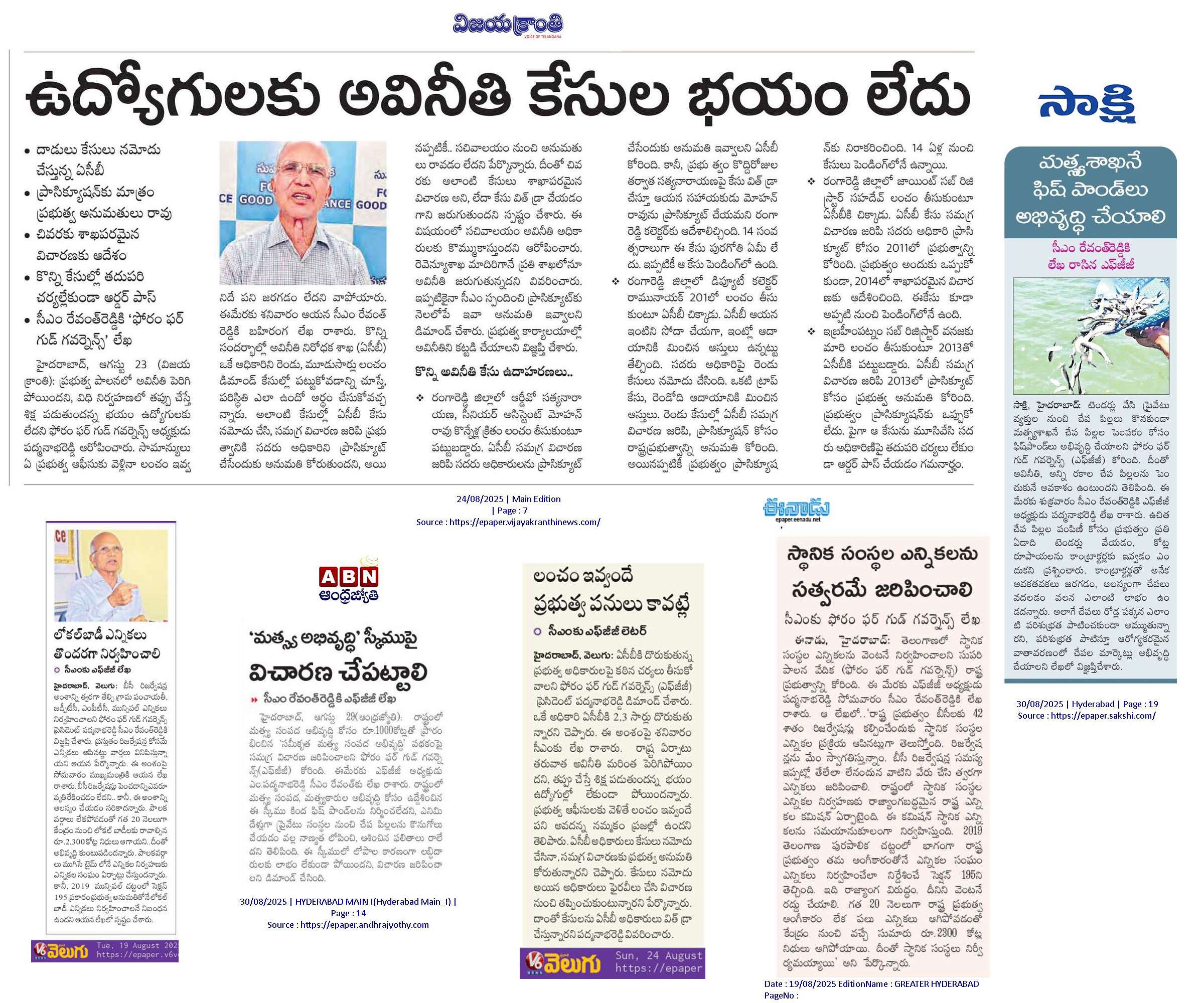
- To the Prl. Secretary, PR&RD department regarding Special Development fund, E.E.s at District level violating the rules, Breaking single work into bits of Rs. 5 lakhs each and allotting the works on nomination basis to party works leading to wastage of public funds, Request for suitable instructions – on 1-8-2025
- To the Secretary, MA&UD department regarding Municipal Building Tribunal, Constitution of Tribunal, Defects in the list of probable candidates, Recall the list of eligible candidates for the appointment of Technical Members of Tribunal – on 1-8-2025
- To the Chief Minister regarding సంగారెడ్డి జిల్లా కేంద్రంలోని సంజీవనగర్ ప్రభుత్వ పాఠశాల దైన్య పరిస్థితి గురించి – on 8-8-2025
- To the Chief Minister regarding Local Body elections, Conduct of elections to all local bodies – on 18-8-2025
- To the Prl. Secretary, PR&RD department regarding Special Development Fund, Splitting the works to facilitate allotting on nomination basis, Effecting the quality of work, Request instructions E.E.s Panchayat Raj not to split the work in NZB constituency – on 19-8-2025
- To the Chairman, Central Empowered Committee regarding further information on PODU – on 21-8-2025
- To the Chief Minister regarding Corruption in administration, ACB cases not pursued Properly, Request to issue suitable instructions for quick disposal of ACB cases – on 23-8-2025
- To the Prl. Secretary, PR&RD department regarding, Misuse of Special Development Funds in Yellandu constituency, Request for inquiry – on 26-8-2025
- To the Prl..Secretary, PR&RD department regarding Special Development Fund – Irregularities in execution of works in Bhadradri Kothagudem district – Aswaraopet Constituency, Request for inquiry – on 26-8-2025
- To the Chief Secretary regarding Indiramma Houses, Illegal collection by middle men for sanction of houses, Request for inquiry by D.G. V&E – on 26-8-2025
- To the Chief Minister regarding Sanction of financial assistance to Telangana State Fishermen Co-operative Federation Ltd., for development of Fisheries sector with an outlay of Rs of 1000 crores during the year 2017-18 and 2018-19 under direct funding scheme of NCDC, Lapses in implementation of the scheme, Request for inquiry – on 29-8-2025
FGG submitted following RTI letters to various departments in the month of AUGUST 2025
- To the PIO, O/o Commissioner, Ramagundam Municipality regarding Special Development Funds – on 1-8-2025
- To the PIO, O/o Executive Engineer, Mission Bhagiratha, regarding Special Development funds – on 1-8-2025
- To the PIO. O/o Executive Engineer, District Panchayat Raj Engineer regarding Special Development funds – on 1-8-2025
- To the PIO, O/o Chief Secretary regarding circulars issued to all local authorities – on 1-8-2025
- To the PIO, O/o Prl. Secretary, School Education department regarding fake certificates – on 5-8-2025
- To the PIO, O/o Executive Engineer, HRDCL, regarding information about works taken – on 5-8-2025
- To the PIO, O/o Director, Agriculture department regarding further information -On 11-8-2025
- To the PIO, O/o Chief Planning Officer, Suryapet regarding Special Development funds – on 19-8-2025
- To the PIO, O/o MPDO, Palakeedu, Suryapet regarding Special Development funds – on 19-8-2025
- To the PIO, O/o Executive Engineer Panchayat Raj division, Naryanpet regarding Special Development Funds – on 19-8-2025
- To the PIO, O/o Executive Engineer Panchayat Raj division, Nalgonda regarding Special Development Funds – on 19-8-2025
- To the PIO, O/o Executive Engineer Panchayat Raj division, Bhadrachalam regarding Special Development Funds – on 19-8-2025
- To the PIO, O/o Managing Director, HMWS&SW regarding Pending bills – on 26-8-2025
- To the PIO, O/o Commissioner, Prohibition & Excise department regarding Toddy – on 26-8-2025
- To the PIO, O/o Director, PR&RE department regarding Unauthorised constructions – on 26-8-2025
FGG TIMES
M. Padmanabha Reddy I.F.S.(R) (President)